Crowd Heart Script Font Review
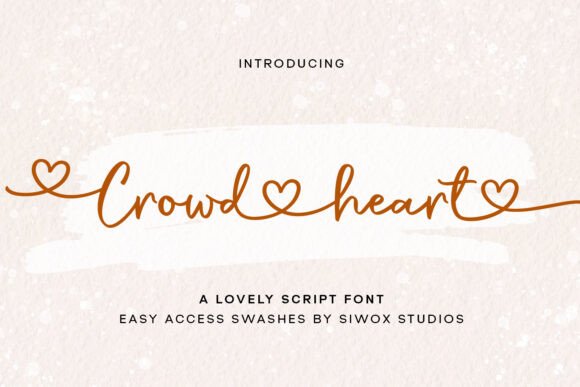
As a web designer, I’m always on the lookout for fonts that bring personality and visual interest to a site without sacrificing usability. Crowd Heart Script has quickly become one of my go-to choices for adding a touch of elegance and warmth to digital projects. Its delicate curves and flowing lines make it ideal for headings, logos, and decorative elements where a human touch can elevate the design.
Testing Crowd Heart Script in a Hero Section
I recently used Crowd Heart Script in a hero section for a boutique online store. The font’s light, handwritten feel complemented the brand’s aesthetic perfectly. It added a sense of authenticity and craftsmanship that felt right at home with the handmade products being sold. When paired with a clean sans serif for the body text, the contrast was visually pleasing and helped guide the user’s eye through the page.
The font performed well across different screen sizes, maintaining its legibility even when scaled down for mobile devices. I found that using it for the main headline created a strong visual hierarchy while still feeling approachable and modern.
Using Crowd Heart Script in Call-to-Action Buttons
Another area where Crowd Heart Script shines is in call-to-action buttons. I tested it on a landing page for a digital course, and the result was surprisingly effective. The font’s subtle swashes and unique shape gave the button a custom feel that stood out from standard button styles. It didn’t overpower the design but instead added a nice finishing touch that felt intentional.
One thing to keep in mind is that the font works best for short phrases. Long text in this style can become hard to read, especially on smaller screens or when placed over busy backgrounds. For CTA buttons, keeping the text concise and using it as a secondary element rather than the primary focus helps maintain clarity.
Pairing Crowd Heart Script with a Clean Sans Serif
Font pairing is crucial in web design, and Crowd Heart Script pairs beautifully with a simple, clean sans serif. I used it alongside a modern typeface for a portfolio website, and the combination felt balanced and professional. The script font added character to the headers, while the sans serif provided a solid foundation for body copy and navigation menus.
This pairing also helped maintain accessibility. By using the script font for headings and the sans serif for body text, I ensured that the site remained readable for all users, including those who rely on screen readers or have visual impairments.
Applying Crowd Heart Script to Landing Page Headers
On a product landing page for a new line of digital templates, I used Crowd Heart Script for the main heading. The font’s soft, flowing lines gave the page a warm, inviting feel that matched the brand’s tone. It worked particularly well when placed over a background image, as the contrast between the font and the visual elements helped draw attention to the key message.
For other sections of the page, such as feature descriptions and pricing tables, I switched to a more neutral typeface to keep the design from becoming too ornate. This approach allowed me to use Crowd Heart Script strategically without overwhelming the user experience.
Considerations for Web Use
While Crowd Heart Script is a beautiful choice for display purposes, it’s not ideal for long paragraphs or dense content. Using it for body text would likely reduce readability and could negatively impact user engagement. It’s best reserved for headlines, subheadings, and decorative accents where its visual appeal can be fully appreciated.
Another consideration is the font’s PUA encoding. If you’re planning to use it on a website, make sure it’s available as a webfont and that the necessary file formats (such as WOFF or WOFF2) are included. This ensures that the font displays correctly across all devices and browsers.
Finally, if you're using Crowd Heart Script for commercial projects, check the licensing terms to ensure it’s suitable for your intended use. Some fonts have restrictions on how they can be used in digital assets, so it’s always a good idea to review the license before implementing it on a live site.